
So you asked the time baseline question of your live-in eater(s) of food and got the answer.
Warm fuzzies all around.
If you had different answers, and the overage tilted in your direction (you think it should take an hour, the other person 30 minutes), you then calmly explained that the more you cook from scratch, the more time it takes. You may have even touched on some of the health and psychological benefits of cooking and eating real food…
More warm fuzzies for everyone. Time disparity solved!
 Yup.
Yup.
At the bottom of a wine bottle.
That’s right up there with the time you first gave your kids broccoli and they loved it so much they not only asked for seconds, but begged you cook them more veggies every day.
In the real world where pink fuzzy unicorns aren’t pole dancing on rainbows, this conversation probably didn’t even go remotely close to how I just described it.
These things take education, and a drink while you’re waiting for it to sink in 😉
Look it’s hard enough figuring all this time stuff out for yourself, and it probably hasn’t been easy or stressless. Starting out in the kitchen can be daunting, and now you have to “educate” someone else??
Yeah that’s a raw deal. No way around it, no magic pill. The only way forward is to come to terms with the anger and ditch it. Remember your end goal, or set one if you don’t have one. Now lets educate:
Consider exactly what you’re saying to your live-in food consumer, and decide whether it’s allowing you guys to come to an understanding or making the kitchen an all-out war zone.
For example, when said significant other is showing irritation at how long you’ve spent preparing a meal (something you may already be stressed about), do you answer with something like, “this stuff takes longer than you think/realize.”
While that is an absolutely true statement, it’s also a dead-end that does nothing to educate or dissipate frustration.
The unfair, but realistic, long and short of it is that time education requires the educator to be the bigger person, when starting out.
You may still be discovering some of this time stuff for yourself, so try being more specific instead and give them (this may include your kids or other family members as well), and yourself, information everyone can store and use.
“I know right. Making this soup from scratch took me 45 minutes to wash, cut, and prepare all the ingredients. In the past we’ve used X and Y that was pre-made, so that’s why it only used to take 15 minutes. I’m excited though, because I know with practice I’ll get faster in the kitchen and this real food is going to make us feel awesome!”
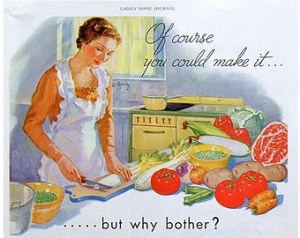
I love this 1935 vintage ad because that may very well be a question you need to be prepared for if you’ve already decided to eat more real food, and come to terms with the time requirements of that decision. Now it’s time to sell that decision in a way that appeals to the others in your household.
Yes, the exclamation point is there on purpose. As completely flakey commercial-like (think 1950s “happy” wife in the kitchen) as that statement sounded, it’s really hard for someone to stay frustrated in the face of positivity.
In other words, excitement is the ultimate frustration-buster.
Of course it’s not going to go exactly like that- the point is to refocus attention on the positive while providing education instead of responding to frustration with frustration…especially if you’re just learning yourself.
It may not work immediately, but it will work if you stick to it. The food-time education will start to take root, and will eventually be anticipated by the non-cook.
Use whatever method works, there is no right way. Some people are visual learners- if so set up a camera one day in the kitchen and record making the person’s favorite dish so they can see what goes into it.
Realistically some people may have never been exposed to the physical process, and that’s a major barrier.
Allow your non-cook to ask questions, and answer in a positive (read: not defensive) way, regardless of how the questions are asked. Or better yet, offer to show them!
Ask them to participate with you, and keep the whole experience positive. Aka when the person mentions that chopping veggies really can take a long time, resist screaming “I TOLD YOU SO” whilst waiving sharp objects and try pleasantly allowing the lesson to sink in instead.
This isn’t being passive-aggressive, it’s removing any excuse for the lesson to not take hold.
Will this work for everyone? No. But that’s not a kitchen-time-education thing, some people are just assholes.
Regardless: Make, and keep, the kitchen a positive place.
This is education.
This is the education people inherently received for generations, but no longer do for reasons we’ll now start to delve into.
This post was a little more action-oriented than previous ones and others will be, but again I hate these websites that throw out solutions wrapped in neat little boxes that are completely friggin unrealistic, and ultimately lead people to frustration and failure.
Know your own time expectations, know the expectations of those around you, and reconcile the two. You may be pleasantly surprised what happens next 🙂
Again, I’m not preaching healthy food or making stuff from scratch- these are just examples and that will always be your decision. Time is a huge factor/stressor regardless of how much or little you cook, and bringing that to the surface is what I really want to focus on here.


So very true!
LikeLike