
The baker and I were discussing the value of school the other day, and it made me think about some small things that have become integrated into our kitchen routine that make a relatively large difference.
For one, sanitation is something that is often overlooked in the home kitchen. No I’m not talking about dirty kitchens, rather food handling practices.
Does it need to be to the level of a professional kitchen? Nah probably not, because you assume risk in cooking for yourself that someone else would have responsibility for in a restaurant environment. Let’s face it, that’s the truth.
 However with the gestation period of some of the more-common food borne illnesses, there have probably been times where you may have accidentally “given” yourself food poisoning at home, eaten out at a restaurant later, and since the starting of symptoms coincided with the last (restaurant) meal it may have been difficult to discern the real cause of illness.
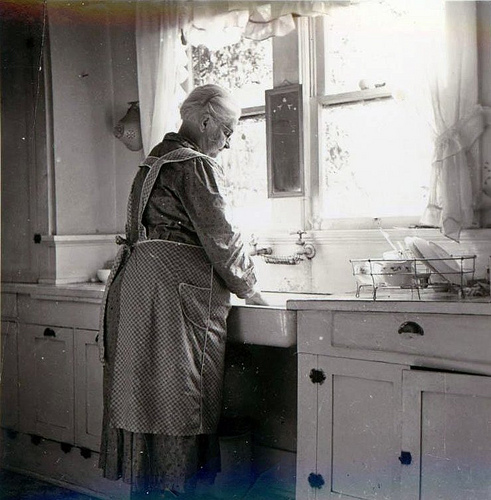
But first, why should you care? Am I just being OCD and spouting from my kitchen pedestal here? After all, our great grandmothers didn’t do a lot of the things I’m about to mention and they were just fine.
Ladies and Gentlemen, if I haven’t hammered this point enough our food sourcing and industry have drastically changed. Your great grandmother was not handling chicken in her kitchen from *insert chain discount grocery here* that’s been raised in unsanitary conditions, pumped full of crap to combat those conditions, and been manhandled by many people on it’s way to your cutting board.
This is the new standard. I’m sorry to say that, but please let it sink in.
We are at a point, right now, where we either have to chose to be very discerning about the source of our food and/or institute some stricter safety standards in the home. This isn’t happening somewhere else: this is your home, your family, and your health.
So here are some often-overlooked ideas to prevent illness and help your food shine:
Wash your sink.
How often do you wash your sink? Be honest. I mean taking the sponge and dish soap and physically washing the bottom and walls of the sink.
We make sure all of our dishes and food are clean, but the dirt and other things that can cause illness have to go somewhere after they’re washed off and leftover suds are not a good sanitation backup plan.
In fact, your sink is one of the most-used surfaces in your kitchen.
 At the very least, wash it once a day or after you’ve had things like, oooohhh raw chicken, in there.
What’s on your board?
Raw and cooked foods really should not be on the same cutting board at the same time, and the board should be washed between these things.
Things like raw meats and fish on a board with anything else is just asking for cross-contamination, regardless of how careful you are determined to be. Life and distraction happen, arm yourself against them and puking later.
Put whatever you’re done working with in a separate bowl, wash the board real quick, keep calm and chop on.
If you’ve got allergies in the house, use different color boards only for specific things. In the professional world this is a common practice, down to the level of different types of meat (beef, fish, poultry) having different color cutting boards, with veggies getting their own as well.
Color coding makes life easy, especially when someone else other than you is cooking in your kitchen (read: children). You’ll be pleasantly surprised how fast people learn which board to use.
Use your rag bin often. Very Often.
The industry standard is single-use paper towels; the towels you see tucked into cooks’ aprons are for handling hot pans, etc., not for cleaning countertops or washing hands. There are frankly just too many germs being held and transmitted in kitchen rags for that to be a safe in a restaurant.
However, this practice may not be economical or environmentally friendly in the home, and I get that- so come to a compromise. Try to use towels only for specific things, and put them in the wash bin (I have a separate smaller basket just for towels in my kitchen) after at most a few days.
 So, the towel for drying freshly washed hands is the towel for drying freshly washed hands and that’s it.
Put it in a specific place and use it for that purpose.
If you’re using the towel you just wiped the countertop with, and then your kids hands (which may not have involved soap), and then the inside of the sink, to dry your hands with…..
….well, why did you waste the soap to wash your hands?
Get rid of other people’s cooties.
The kid with norovirus that’s tapped every single apple at the store because it’s fun just invited himself into your home via your shopping bag.
The point here is that salmonella isn’t the only thing entering your house through your kitchen. Give your fruits and veggies a quick rinse and dry right before use, and use those little sanitation wipies at the store on your basket. It makes a huge difference, especially during flu season.
FYI- Placing unwashed veggies on a cutting board, washing them, and then placing them back on the same cutting board defeats the purpose 😉
First World Problems.
This isn’t a sanitation category per say, but it’s something to keep in mind.
I’ve heard ideas like these being touted as “First World problems” in some circles, and that sounds just about as as stupid to me as “my great grandmother did it so it must be fine.”
The overarching point here is to not get caught in the cycle of using other people as justification, because circumstances are usually not the same in the comparison.
If you’ve been raised in an environment with poor sanitation practices, you’ve most likely developed antibodies to cope with that. Saying someone in X country doesn’t wash their sink and they’re fine so I won’t either is just a ridiculous comparison.
When making sanitation decisions, take into account your history and your current situation- not someone else’s in a different country, 100 years ago, or even your friend Jane.
Our current food distribution system is what it is, and change in that arena is going to take a long time.
This isn’t to rail on the current situation, it’s to educate and allow adaptation to our current food situation. We have to be wary of what was “safe” even 50 years ago, because those same things may not be produced in the same way anymore.
It’s just a realistic viewpoint. If you’re curious, go find out how your favorite items are sourced and processed. It’s startling to find out how many people are actually handling our food before it gets to us.
You may begin to find many of the broader regulations we have today are a result of mass production, and not the foods themselves being dangerous…. but that’s another post 😉
 Peel & Cleaver
I am proud to say I do every one of these! I am a total germ freak after going through a year of daycare and I know all things about norovirus….hopefully I can prevent the whole house from going down with it when carter starts bringing it home from pre-k!
LikeLike
As someone who does home canning (and brewing and other such endeavors that benefit strongly from proper sanitary practices), this really resonated: “We have to be wary of what was “safe” even 50 years ago…” Simple ignorance on the part of amateurs is understandable, but is worsened by people who put themselves forward as experts yet are apparently unaware of advances in sanitary practices or the role that larger cultural norms play in the assessment of a practice as “safe”.
So, for example, while “oven sealing” jars worked for great-grandma, great-grandma also boiled the green beans extensively before final service. We’re less likely to do that [e.g. cultural shift], which means that particular possibility for increasing the safety of the food doesn’t happen, so earlier stages need to be more thorough/careful.
And that’s even without getting into, say, reasonably modern scientific research that illustrates the previously-unknown lives of bacteria/contaminants that exist beyond the eye of the casual observer, such as their actual tolerances for heat/time/cleaning agents/etc etc etc.
-Mary Beth, who apparently has Strong Feelings About This, yet admittedly only washes the sink every couple of days unless there has been raw poultry, but consciously gauges this is an acceptable risk in a household containing only two adults, neither of whom are immuno-compromised 😉
LikeLike
How in the world did we all survived 50-60 years ago and even longer!!
LikeLike
Haha Mum- that’s exactly the point 😉
LikeLike
Mary Beth that’s an absolutely phenomenal example. We have an acronym- FATTOM- we are taught to help determine risk that I use in my home kitchen almost daily, that touches on some of the same principles you were just describing.
I am a huge fan of doing things the “old fashioned way,” especially if those methods help us eat more real food. But when we go down that road we can’t just pick and chose which parts to use, we have to look at the entire process and adapt it to current times. I never would have thought about the taste/mouthfeel preference of today’s eaters with the green beans but you’re totally right. Damn what a fascinating thing.
LikeLike
Mrs Canerday, that’s awesome 😀
LikeLike