
What a topic this is.
I recently read this article about certain restaurants deciding they wouldn’t like to have young children present at their establishment, and oh my the comments ranging from applause to flaming outrage.
Why is this such an incendiary point in the States? I’d like to consider this from both the restauranteur/cook and parent perspectives, which I initially thought would clash more than they do honestly.
As a parent of a 3-yr-old, I want to have opportunities to train my kiddo on how to act appropriately at a restaurant; how to order, how to keep her voice at a respectful level but still join in the conversation, how to be patient waiting for food or waiting for others to be done. And, to share in a good meal with her! It is a fully consuming task for these lessons to be taught, as you have to be consistent for them to sink in, and I often find dining out is more tiring from a parental-attention-needed point of view than eating at home.
As a parent of a 3-yr-old, I also want to enjoy an adult atmosphere in peace on the rare opportunities I do get to dine out without my bestest little girl with me. No, I don’t want to hear another child scream, or bang silverware while they’re learning what gentle means, or even talk respectfully at the table next to me. It’s my break, I’m in an adult setting (which rarely happens), and I most likely worked my ass off to earn being there.
No apologies, it’s the bare truth.
Is that a jerk perspective? Think of it like going to a restaurant at the end of a super long day to relax and your boss or co-worker (the one that talks everyone’s business at the waterhole) walks in. Maybe they don’t even see you, but already your evening has changed. You just wanted to relax, but now you’re stuck looking over your shoulder waiting for the other shoe to drop– probably not talking about or doing what you wanted to talk about or do.
This is what it’s like to varying degrees when a parent, especially one who is a daily primary caretaker (or stay-at-home if you prefer), goes to an adult restaurant, in what would be considered an adult setting, and there is a young kiddo sitting next to them. Even if the little person is being angelic, it still changes what you’d say and how you’d act because you have to put your parent mouth on (i.e., be mindful of language usage, certain topics, etc.). The parent mouth you just. took. off. but the couple that brought their child is expecting you to have because hey, it’s a kid.
Just leave and go to a different place? Not when you’re on a babysitter’s clock, or it’s a weekend night in D.C. or Seoul or many other cities where reservations are a must. Just continue on as if the kiddo isn’t there in regards to the parents mouth? Meh. I’ve found it’s always a bad idea to put a kiddo in the middle of an adult issue–it’s not their fault and shouldn’t bear that burden.
What parenthood has taught me in this situation is that it doesn’t matter how impeccable your kid’s manners are, inserting a child into what should be an adult dining atmosphere in the States is just not fair to the other patrons, because the child’s very presence affects their ability to relax.
No, it is not an attack on families or a personal attack on a kiddo’s impeccable manners, at all. It’s more about respecting people in a group setting, and frankly, the restaurant itself.
I’ll go out on a limb and say my kiddo has pretty stellar restaurant manners, and I’m both extremely proud of her for it and happy the work we put into it is paying off. I take my kiddo pretty much everywhere with me– she’s an amazing traveler and we’ve had some crazy experiences; but I still wouldn’t bring her to a restaurant where it wasn’t appropriate to have a kiddo her age there- be it the restaurant itself or the time of dining, because I know how I’d feel if the situation were reversed.
(To be clear I’m talking about dining in the States here; other countries have different perspectives surrounding raising children and taking them to eating establishments. More below)
From a restaurant PoV, I absolutely support the right to restrict patronage. We’ve developed this idea these days that everyone needs a participation medal for everything, and we all get to do anything we want. However business owners have the right to tailor their product and environment to their own vision, and we need to rekindle our respect for that. And it is, again, not at attack on children or families, rather it’s respecting the rights of entrepreneurs. These ideas are not correlated, they are two separate things.
However this is a broader topic than just mere presence at a restaurant, so let’s dig down to the roots that are flaming the fires:
1. Americans treat kids like shit in restaurants. It’s true. We relegate them to a kids menu that most of us wouldn’t want to eat, which consists of fried, processed, incomplete crap (how about a protein with that “mac & cheese” instead of a lonely bowl of overcooked pasta tossed with cheese product).
We give them foods that are loaded with sugar and fried, and then expect them to sit still– that’s actually called setting a little person up for failure. Would you give a toddler cupcakes before a 4-hour plane ride? No different. And frankly it’s insulting to think a child couldn’t handle eating real food off of a real menu, and be at least capable of exercising a little patience at a public table.
Think about it...we adults lose our minds when someone treats us differently because of our gender or skin color, etc., but in a restaurant we immediately segregate our children with crap food and lowered expectations and think it’s normal. Do the math.
2. People have the right to have a decent meal, that they’re paying for, in peace. I hit on this earlier so I won’t linger, but we need to enter it into our rubrics that the people around us have the right to enjoy their meals in peace without being part of our parent training time if it’s not an appropriate time for that to be occurring.
It seems like parents these days almost demand tolerance from the people sitting next to them if their child is losing it, but you never know what the person next to you has going on, or what they’ve just been through– the only thing you can control here is what you bring, or don’t bring, to the table.
3. Restaurants have the right to restrict their clientele. We get incensed these days about anyone restricting anything that we forget to step back and ask ourselves what it actually means to us. This is a basic psychological pattern advertisers use to drive up value, because when we’re told we can’t have something, even if it’s something we didn’t want, we tend to falsely value it more.
So when we see a sign that says “No Children Please” we get enraged instead of asking, well did I even want to go there in the first place? And did I want to go with my child, and if I did is it only because I wanted to go and my child just happens to be with me?
Step back and identify the source of the anger– it’s probably not because of the restaurant or the sign. Parenting can be super rough, lightly put, so it’s no wonder there’s an intense desire to feel like an adult again and recapture a little of that prior freedom of just getting to sit at the bar and order, or having 12 seconds of free time that isn’t filled with planning for a kiddo.
However as parents we must keep in mind that kids are only young for a finite amount of time, and this phase too shall pass. We can’t shift the burden of our desires to recapture past freedoms onto the people around us by bringing our kiddos somewhere we, deep down, know we probably shouldn’t.
There are a lot of restaurants out there; if one of them is restricting or discouraging kids it’s not a place you want to go with your kiddo anyway because you’ll never relax. And then what’s the point? Even though we may not agree with the restauranteur’s decision, we can still, and must, respect that it was theirs to make.
4. We suck at bringing kids to restaurants. Royally. We inherently expect kids to behave like jerks in restaurants these days, and the great thing about young kids is that they’re really good at living up to expectations. Especially the ones we don’t vocalize.
We also walk into restaurants completely entitled, expecting highchairs and booster seats and changing tables and free entertainment in the form of crayons and other items. We bring in a bunch of junk that clutters the area around tables and entrances, but again feel it’s our right to do so and don’t bat an eye. I’ve seen parents get a stroller out of a car, to walk to a restaurant from the parking lot, to then take the toddler out of the stroller, leave it up front, and go sit at table. Huh?
The bottom line here is that parents have come to expect to be catered to in restaurants, and man that’s kind of irritating from a restaurant, other patron, and other parent point of view. No wonder some establishments are questioning if they want to open themselves up to that.
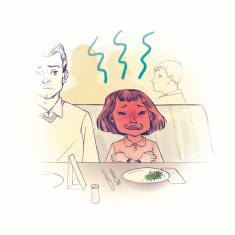
So instead of this spiral of negativity above, what about shifting our outlook to create an environment where parents, parents flying solo, patrons without kiddos, and restaurants can work together to the benefit of all. Let’s start to:
Be Respectful. As a parent, look past the parent pride for a minute (and pat yourself on the back on the way if you’ve worked hard and have a well-behaved kiddo), and don’t bring your kids to a restaurant where you wouldn’t want to be sitting next to a kiddo, even an angel child, when you’re flying solo. Just be a bigger person here and make the realistic call, because it’s not the 3-yr-old that wants, or cares, about the ambiance of the candlelit table or the superb duck on the menu. It’s us. Save those moments for when you can truly appreciate them solo, and can actually get what you’re looking for out of the experience.
Be Respectful, Again. If a restaurant decides it would rather engage a more adult clientele, respect the decision and hey, even make a reservation for a date night. Or if you don’t have kids and don’t care to dine with them, put the place on your list! Remember, the policy isn’t an attack on a child or parenting skills, so don’t waste time and energy on internalizing what was a purely business decision for the establishment.
Raise the bar for kids. This is the big one. Expect better behavior from them, and stop tolerating parents who don’t set the bare minimum of this bar (i.e. letting kiddos run wildly around restaurants -which is pretty dangerous with trays of hot food being carried around-, or emptying sugar packets on tables so they can draw designs in them. Would that be tolerated at home? Doubt it). Be responsible and bring something for children to engage in if they don’t have a long enough attention span to sit through an adult-length meal, but still expect them to behave well while doing so.
And stop being mean to waitstaff when food doesn’t instantly arrive at the table; try introducing patience an option for the kiddo instead.
When little people are just having a rough day and can’t meet our expectations, which happens, be willing to leave or at least bring them outside or away from the main dining area to correct it, out of respect for the other patrons and the staff. A public restaurant isn’t the place to let them “scream it out” because they’re power-playing for attention and we’ve got our sights on seeing through an epic parenting victory.
The last one is a tough call I realize, so I won’t leave it hanging out there like it’s an easy decision. Do you let them win by leaving if that’s what the tantrum was for, or do you stay and be disrespectful to the other patrons? The answer might involve compromise on both parts if you want to stay and enjoy a meal, perhaps offering them something they can earn in exchange for their good behavior.
As parents it raises the hairs on the back of our necks to compromise in these situations, because when you compromise with a toddler it’s basically akin to losing and you don’t want them to go for the mile after you’ve just given them an inch.
And they always do. *laughing sigh*
But in public places, discipline isn’t black and white. We’ve got to chose what’s more important, the full lesson being learned or the meal we wanted out; whatever the choice ends up being, own it and don’t push the frustration of being in that situation back onto the kiddo, or their minor eruption will turn Vesuvius-style in a heartbeat. These are the -lose the battle to win the war- parenting moments where we have to decide what we value more without dragging everyone else around us into it.
Help Other Parents. In this country we’re really good at turning a blind eye, even as parents, towards parents having trouble and THIS is one of the big reasons we have a lot of these restaurant sticking points in the first place!
Before I was a parent I used to just sit and stare when trouble would erupt with someone else’s kids–because I didn’t know what to do, because I was annoyed, and because I didn’t think they wanted me to ask anyway. I thought saying something would embarrass them.
Now I know that just the simple question is often enough to help, and if you can you should always, always, ask if you can help. Funnily enough I was going to add that better yet, you should just act, however we live in such a litigious society I don’t think I can recommend that here. That aside, sometimes a parent just needs the small reassurance they’re not alone on an island with a melting down toddler and your asking or even seeing warmth in your eyes can give them the strength to buck up and find a better way to help their kiddo. Which in turn helps you, because the situation is then resolved faster.
I’ve done a lot of solo traveling with our little girl, both inside and (mostly) outside of the country. Not because I’m some super parent, it was all circumstantial and necessary. Throughout all of this I’ve been in many unique circumstances with my kiddo, and I’ll tell you when the brown stuff hits the fan the one guaranteed thing that immediately expounds my stress is when people are just staring at me, angrily and/or accusingly– it makes an already taxing situation much worse, and when your little one senses your new higher level of anxiety they lose it all the more.
See the cycle here?
All this ties in together, because parents who are empowered simply by knowing the adult at the next table isn’t going to be an instant jerk can more effectively and calmly navigate challenges that may arise when eating out with a little bit. Which then in-turn helps them train said little one better so less challenges occur in the future. If we start, as a culture, to give parents the idea that we have confidence in them to succeed, and not expect their kids (and through that them) to fail, some of the issues I mentioned above will start to resolve themselves. However parents still need to take the first responsible step by not bringing their kiddo somewhere they probably shouldn’t either. Reference all above.
If you don’t have kiddos and you’re reading this, the question may arise, “well it wasn’t my choice to have kids, why should I be involved?” Valid question, and one I used to have. And one, after living in several different cultures, I’ve noticed is pretty much only asked in this country… almost everywhere else we’ve lived there has been a very communal approach to raising children, and that approach gives parents confidence, etc etc.. The cycle should be evident at this point.
I’m not sure where we lost the bubble on the value of furthering the species in our country, but I do know I was wrong in my earlier years to apply the “your kids, your problem” label to people with children. In truth, we need the younger generation- we need cooks and doctors and pottery makers and lawyers and bicycle experts and masseuses and even weathermen too. That’s how progress happens.
And we need them to not be assholes.
Even if you don’t want or like kids (I didn’t for a very long time, I know how it feels), someone else has chosen to take on the huge responsibility of growing a contributing member of society…a member you may need someday when they’re on the other end of the 911 call. That’s why it’s never an isolated “they had kids, not my problem” thing, because that child will grow up to be member of the global community we all share and contribute in a way we may need to benefit from later on down the line. Reciprocal.
Bend over backwards? No, of course not. And likewise, people with kiddos aren’t entitled to the world either. We can find a middle ground of respecting the space of non-parents (or solo parents), and also seeing if parents in a bind need a few minutes of help and kindness.
Or, even just patient understanding that no one, ever, woke up and thought -damn I really hope my kid loses it today, that would seriously make my day-
Out of all the levels we’ve woven through on this topic, the biggest take away here for me is respect.
Treating our kids with respect and empowering them instead of segregating them and expecting them to fail.
Treating the people around us, with or without kids, with respect through our dining decisions and helping actions.
And treating restaurant owners’ decisions with respect.
If that’s our going in point much of this resolves itself on it’s own, and we all get to break bread how we were meant to– bringing more of the things we value to the table.


Brilliant!! Just Brilliant! Being a Grandmother who love children – there is a time and place for them. In this world where both parents work – who are not taking the responsibility or time to really train or mold their children for the outside society. In agreement with the restaurants, if they want a total adult enviroment, is their choice and we the people, should respect and acknowledge their request. Nothing more pleasant than going out to a wonderful meal and enjoying a nice peaceful ambiance!
LikeLiked by 1 person
Being a few decades removed from coping with that unexpected mid-restaurant meltdown and doing what we could to mitigate it, your perspective sure brought back similar thoughts. And continued frustrations.
While we haven’t run across many restaurants that have a “no children” policy, like so many other business-owner decisions, we’d fully support it. If it was a policy that we couldn’t support, we’d just go elsewhere.
But that also seems to be a level of personal responsibility that is lacking in those parents that are screaming about the “no children” policy.
LikeLike